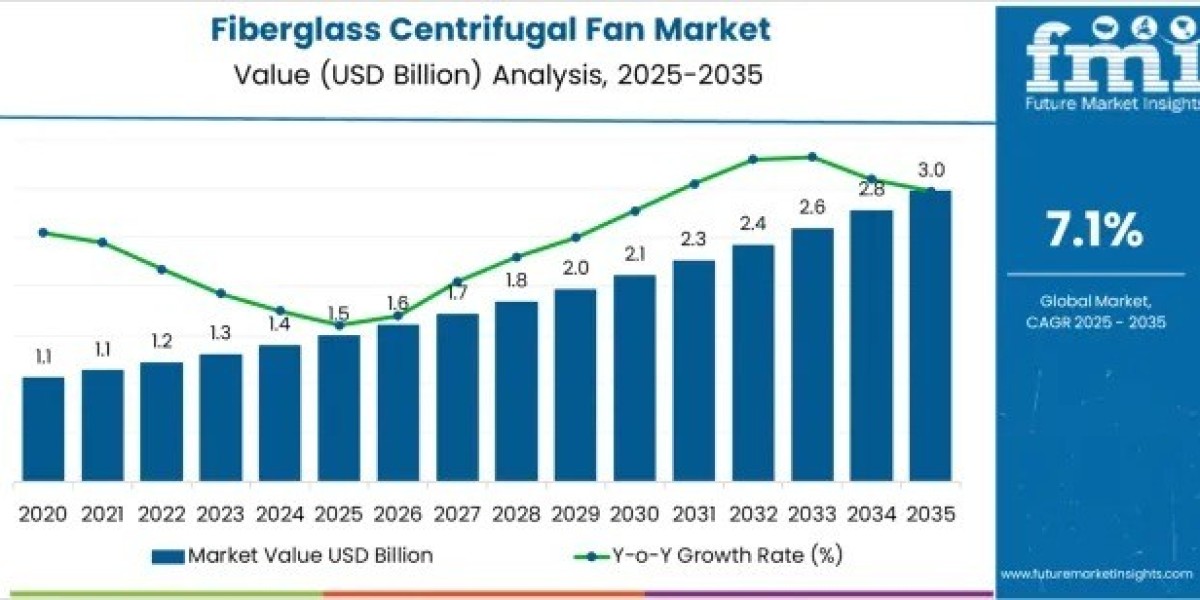

The Fiberglass Centrifugal Fan Market is on a strong growth trajectory, expanding from USD 1.5 billion in 2025 to USD 3.0 billion by 2035, supported by a sustained global push toward corrosion-resistant, energy-efficient air handling systems. With a projected CAGR of 7.1%, the market is accelerating as industries confront stringent emissions rules and seek long-lasting ventilation solutions capable of performing reliably in aggressive chemical environments.
Subscribe for Year-Round Insights → Stay ahead with quarterly and annual data updates
https://www.futuremarketinsights.com/reports/sample/rep-gb-28275
Across chemical processing, pharmaceuticals, wastewater treatment, semiconductor fabrication, and agriculture, operators are replacing metallic fans with composite alternatives that deliver superior corrosion resistance and reduced maintenance requirements. This shift is reshaping procurement priorities, pushing manufacturers to innovate in composite technology, aerodynamic design, and automated fabrication methods.
Industrial Demand Drives Market Momentum Through 2035
Industrial applications remain the undisputed backbone of the fiberglass centrifugal fan market, accounting for over 91% of total demand in 2025. The sector depends heavily on fans that can withstand constant exposure to acids, alkalis, ammonia, solvents, and corrosive gases.
Growth drivers include:
- Expansion of chemical processing facilities across Asia Pacific and North America
- Rising regulatory pressure for emission control, worker safety, and industrial air quality
- Wastewater treatment modernization, especially in developing economies
- Escalating pharmaceutical production, requiring contamination-controlled ventilation systems
Single-grade fiberglass fans hold the major share—56.9% in 2025—due to cost efficiency and broad industrial suitability. However, multi-grade glass fiber fans are gaining rapid traction in high-risk chemical environments and semiconductor facilities where extended service life and elevated chemical resistance justify premium pricing.
Asia Pacific Leads Global Growth; North America and Europe Show Steady Upgrades
Asia Pacific continues to outperform all regions, with China and India exhibiting CAGRs of 9.6% and 8.9%, respectively. Massive chemical manufacturing bases, rising environmental enforcement, and large-scale infrastructure modernization are driving adoption.
Key regional highlights:
- China: Rapid expansion of chemical clusters, wastewater upgrades, and stringent emission norms
- India: Strong industrial development supported by pharmaceutical and specialty chemical growth
- Europe: Market rising from USD 427.4 million (2025) to USD 846.2 million (2035) with Germany leading at 38% share
- North America: High compliance standards and significant wastewater modernization programs
- Japan & South Korea: Focus on premium-grade, precision-engineered fiberglass ventilation systems
The growing preference for high-performance composite fans is also linked to lower lifecycle costs, reduced downtime, and the ability to maintain stable performance in corrosive and high-humidity environments.
Technological Advancements Strengthen Market Appeal
Manufacturers are heavily investing in next-generation composite solutions. Innovations shaping the 2025–2035 landscape include:
- Advanced resin formulations and reinforced fiber matrices for higher chemical resistance
- Optimized impeller geometry reducing energy consumption and improving airflow efficiency
- Automated fabrication processes ensuring consistency and accelerating production
- Customization capabilities tailored to the chemical, semiconductor, and wastewater sectors
These advancements are widening the performance gap between fiberglass and traditional metals, reducing operational costs and improving long-term reliability for end users.
Challenges: Cost Barriers, Temperature Limits, and Installation Requirements
Despite strong growth, the industry faces obstacles:
- Higher capital costs compared to metallic centrifugal fans
- Temperature limitations, which restrict use in extremely high-heat environments
- Specialized installation expertise needed to optimize performance and ensure safe operation
- Maintenance training requirements for facility technicians unfamiliar with composite structures
However, increasing environmental regulation and industrial modernization are expected to outweigh these challenges, sustaining double-digit growth in several regional segments.
Competitive Landscape: Expertise and Engineering Capabilities Define Market Leaders
The market is shaped by manufacturers with deep composite engineering expertise, strong application support, and proven reliability records. High switching costs—linked to installation expense, performance validation cycles, and compliance requirements—favor established players. Leading companies include Greenheck, Twin City Fan & Blower, and Hartzell Air Movement, each leveraging extensive portfolios and service networks.
As industries demand more customization, performance validation, and data-driven engineering support, suppliers offering advanced composite designs and application-specific solutions are expected to dominate premium segments.