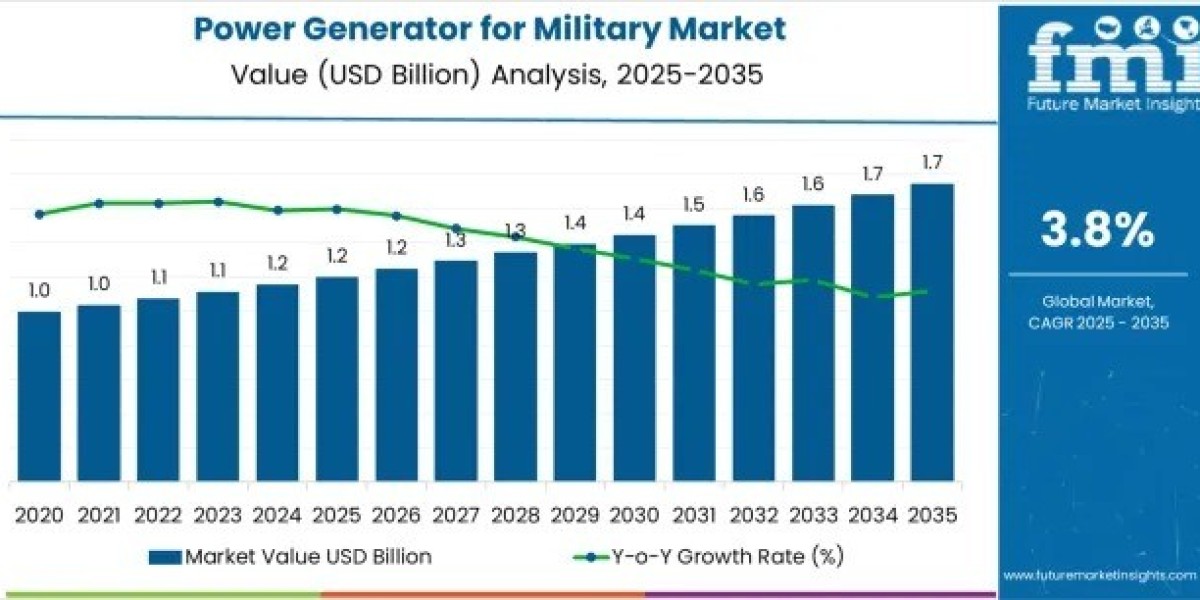

The global Power Generator for Military Market is projected to rise from USD 1.2 billion in 2025 to USD 1.7 billion by 2035, reflecting a steady CAGR of 3.8%, according to recent data analysis. This growth trajectory is fueled by defense modernization programs, expanding C4ISR (Command, Control, Communications, Computers, Intelligence, Surveillance, and Reconnaissance) infrastructure, and the increasing adoption of hybrid diesel-battery-solar systems for energy efficiency and field reliability.
Subscribe for Year-Round Insights → Stay ahead with quarterly and annual data updates https://www.futuremarketinsights.com/reports/sample/rep-gb-12533
Modern Warfare Demands Resilient Power
As armed forces integrate electronic warfare platforms, real-time communications, and advanced surveillance systems, the demand for uninterrupted, mobile, and fuel-efficient power generation continues to escalate. Military planners are shifting focus from raw power output to mobility, resilience, and efficiency, pushing manufacturers to develop compact, smart, and ruggedized systems.
By 2030, the first growth phase will be defined by rising defense budgets and the modernization of existing bases. Procurement priorities are gravitating toward rapid-deployment units, energy-efficient generators, and renewable-compatible systems capable of operating in off-grid or tactically sensitive environments.
Hybrid Systems Redefine Military Energy Infrastructure
Hybrid power systems—combining diesel, battery, and solar inputs—are increasingly shaping next-generation defense operations. These units reduce fuel dependency by 30–50%, enable “silent watch” capability, and minimize the logistical burden of fuel transport to forward-deployed forces.
By 2030, hybrid systems are expected to account for 35–40% of total market revenue, up from under 10% a decade ago. Traditional diesel generators will continue to dominate legacy applications but face gradual displacement as digital monitoring and low-signature designs gain traction across tactical platforms.
Market Breakdown: Where Growth Is Concentrated
- Market Value (2025): USD 1.2 billion
- Market Forecast (2035): USD 1.7 billion
- Growth Rate: 3.8% CAGR
- Leading Capacity Range: 61–250 kW
- Primary Application: C4ISR and Communication Systems
The 61–250 kW capacity segment leads with 36% market share, owing to its balance between power capability and operational flexibility—ideal for command posts, field communications, and forward bases. These generators are designed for parallel operation, hybrid integration, and compatibility with JP-8 military fuels.
Smaller units (up to 60 kW) cater to special operations and mobile applications, while larger systems (above 500 kW) serve logistics hubs, radar installations, and naval facilities.
Regional Overview: South Asia and North America Lead Growth
Regionally, the South Asia Pacific and North America markets dominate demand, supported by major defense expansion initiatives and infrastructure upgrades.
- India (4.1% CAGR) leads globally, driven by border electrification projects in high-altitude zones such as Ladakh and Arunachal Pradesh, where hybrid and cold-weather-hardened units are in high demand under the Atmanirbhar Bharat defense initiative.
- The United States (3.8% CAGR) maintains leadership through advanced hybrid deployment programs across expeditionary forces and forward operating bases.
- South Korea (3.7% CAGR) invests in automated, unmanned power systems for border surveillance.
- Saudi Arabia (3.6% CAGR) focuses on climate-hardened systems for desert operations.
- The European Union (3.5% CAGR) emphasizes NATO-standardized, low-emission generators as part of defense sustainability goals.
Key Trends Shaping the Future
- Hybridization & Silent Operations:
Integration of solar arrays and battery systems with diesel units enhances fuel efficiency and stealth, critical for covert and special operations. - Smart Energy Management:
Predictive maintenance and IoT-based diagnostics enable real-time monitoring, reducing downtime and maintenance costs. - Low-Signature Tactical Systems:
Stealth-oriented designs with reduced infrared and acoustic emissions are gaining prominence among special forces and expeditionary units. - Sustainability & Modularization:
Containerized microgrid-ready generators and biofuel-compatible engines are aligning with defense sustainability mandates.
Competitive Landscape: Innovation Defines Leadership
The market features 15–20 established players, with top manufacturers holding nearly 70% of total revenue. Global leaders include:
Caterpillar Inc., Rolls-Royce Power Systems (MTU), Cummins Inc., Kohler Energy (formerly KOHLER-SDMO), and Generac Power Systems, Inc.
These companies are actively advancing hybrid integration, MIL-SPEC ruggedization, and condition monitoring services to differentiate from standard diesel units.
Innovation-focused companies are expected to dominate procurement cycles, as defense agencies prioritize digital-ready, hybrid-compatible generators for operational sustainability and reduced logistical strain.