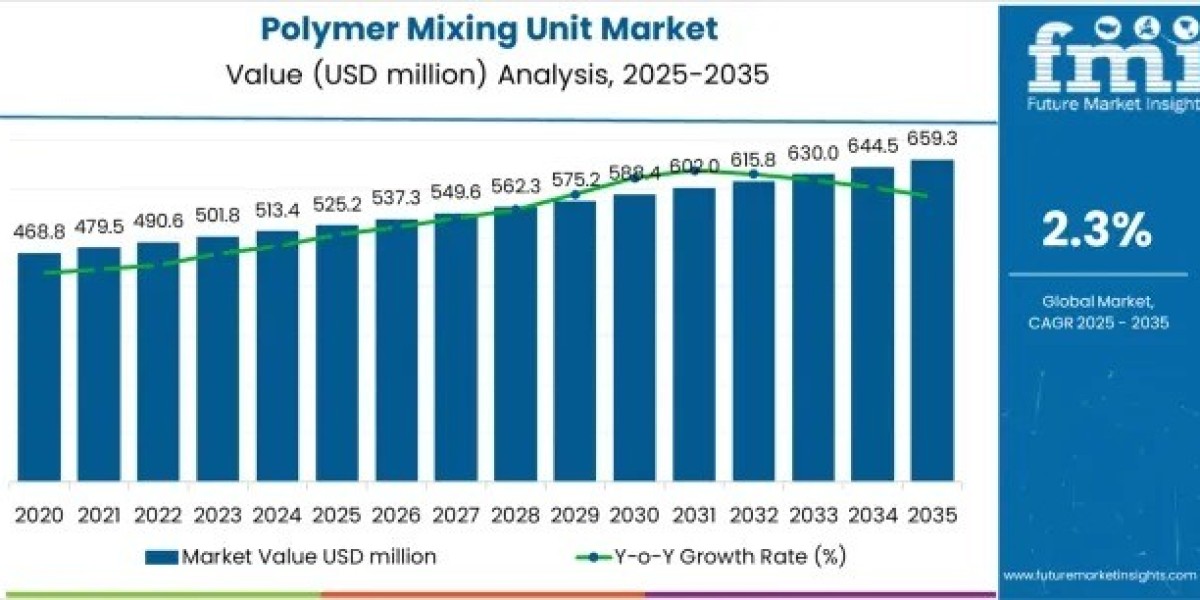

The global Polymer Mixing Unit Market is poised for sustained expansion, advancing from USD 525.2 million in 2025 to USD 659.3 million by 2035. This demand surge corresponds with mounting global pressure to upgrade aging water infrastructure, enforce tighter effluent discharge standards, and improve overall treatment efficiency in municipal and industrial facilities. As countries invest in water resilience and industries pivot toward operational optimization, polymer mixing units have emerged as essential equipment enabling accurate polymer preparation, enhanced flocculation, improved sludge dewatering, and consistent contaminant removal.
Subscribe for Year-Round Insights → Stay ahead with quarterly and annual data updates:
https://www.futuremarketinsights.com/reports/sample/rep-gb-27894
By 2035, market value is expected to grow by over USD 134 million, supported by a rising emphasis on automation, sustainability, and digital monitoring. Industries such as power generation, food processing, petrochemicals, and pulp and paper are increasingly deploying automated polymer mixing systems to achieve precise dosage control, reduce chemical waste, and streamline operator workload. The transition toward energy-efficient and smart water treatment technologies is another significant catalyst driving global adoption.
Market Drivers: Infrastructure Investment, Regulatory Compliance & Operational Efficiency
Massive global investments in water and wastewater treatment infrastructure remain a central growth driver. Urbanization, population expansion, and industrial development—particularly in Asia Pacific and North America—are creating an urgent need for advanced chemical conditioning systems. Meanwhile, stricter regulatory enforcement on discharge quality and drinking water safety continues to reshape treatment standards, compelling utilities and industries to upgrade polymer dosing technology.
Automation is becoming a defining feature of modern treatment systems. Intelligent polymer mixing units with automated dilution, flow-paced dosing, and real-time monitoring capabilities are helping facilities reduce downtime, optimize chemical use, and align with digital water management strategies. Additionally, sustainability goals are encouraging energy-efficient designs that minimize power consumption and support long-term environmental compliance.
Material Form & Application Dynamics
Liquid polymer systems dominate the market with 57.3% share in 2025, driven by their ease of handling and installation. However, powder-based systems continue to gain traction—particularly in large-volume municipal and industrial applications—due to their lower chemical cost, reduced storage requirements, and growing advancements in powder wetting technology.
Wastewater treatment remains the largest application segment, accounting for 44.6% of total demand. Expanding municipal treatment capacity, intensifying biosolids dewatering needs, and rising industrial water recycling are sustaining this segment’s leadership through 2035. The paper and chemical industries are also contributing significantly to market momentum as they modernize treatment operations and pursue efficiency improvements.
Regional Outlook: Asia Pacific Leads, North America & Europe Maintain Steady Growth
Asia Pacific dominates the global market with 38.7% share, benefiting from rapid urbanization, heavy government investment in wastewater treatment infrastructure, and industrial expansion across China, India, and Southeast Asia. China alone is expected to reach USD 83.5 million by 2035, supported by nationwide environmental protection mandates.
India follows with strong growth momentum driven by national water rejuvenation initiatives and industrial treatment upgrades. Europe and North America remain stable, mature markets where aging infrastructure replacement and high environmental standards sustain equipment demand. Germany, a global leader in water technology, is projected to reach USD 63.5 million, while the U.S. is forecasted at USD 48.3 million by 2035.
Market Outlook: Technology Integration, Energy Efficiency & Modular Growth
The Polymer Mixing Unit Market is increasingly shaped by three core trends:
- Automation & Smart Water Technology
Integration with SCADA, data analytics, and remote monitoring is empowering operators with actionable insights for precision chemical management. - Sustainability & Energy Optimization
Facilities are prioritizing equipment that reduces chemical dosing errors, lowers operating costs, and minimizes energy waste. - Modular, Skid-Mounted Systems
Rapid deployment models are gaining popularity in decentralized treatment sites, emergency installations, and industrial expansion projects.
Despite strong market fundamentals, challenges such as municipal budget limitations, long equipment lifecycles, and competition from alternative treatment technologies persist. Nonetheless, rising global demand for efficient water management solutions positions polymer mixing units as indispensable assets for the next decade.