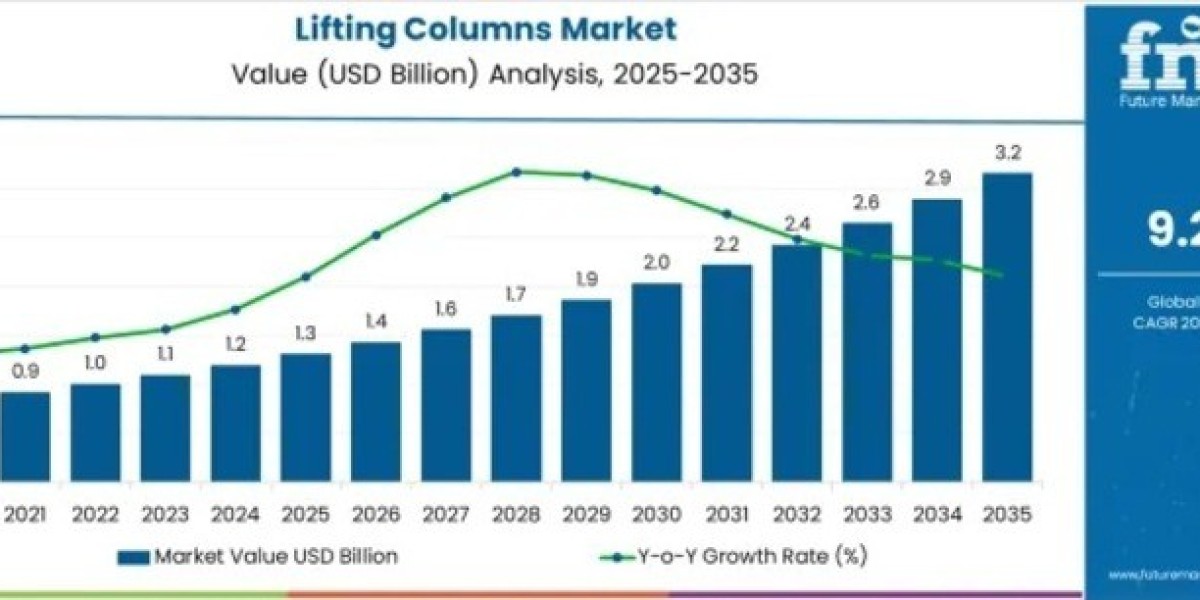

The global lifting columns market is poised for robust expansion through 2035, fueled by automation in manufacturing, ergonomic workplace demands, and advancements in smart furniture and healthcare equipment.
According to Future Market Insights (FMI), the market is valued at USD 1.3 billion in 2025 and is projected to reach USD 3.2 billion by 2035, expanding at a compound annual growth rate (CAGR) of 9.2%.
The FMI report, “Lifting Columns Market Size, Share, and Forecast 2025–2035,” indicates global revenues will surge by nearly USD 1.9 billion over the decade, propelled by rising adoption of electric and modular systems for precise height adjustments in industrial, medical, and office settings.
Subscribe for Year-Round Insights → Stay ahead with quarterly and annual data updates: https://www.futuremarketinsights.com/reports/sample/rep-gb-8730
A Decade of Growth Anchored by Electric Automation and Ergonomic Precision:
The shift toward electric, IoT-integrated lifting solutions is redefining operational efficiency and user safety. Between 2025 and 2030, the lifting columns market is expected to add USD 900 million in value, driven by infrastructure upgrades and healthcare modernization.
From 2030 to 2035, FMI projects an additional USD 1 billion in growth, highlighting deeper integration of programmable controls, energy-efficient designs, and high-load-capacity modules in smart manufacturing and adjustable workstations.
“Electric lifting columns are revolutionizing how industries approach height adjustability, blending precision engineering with seamless automation,” said an FMI research analyst. “Advancements in ball screw technology and modular compatibility are not just enhancing productivity—they're setting new benchmarks for sustainability and worker well-being.”
Lifting Columns Key Market Insights at a Glance:
- Metric: Global Estimate
- Market Value (2025): USD 1.3 billion
- Forecast Value (2035): USD 3.2 billion
- CAGR: 9.2%
- Top Mode of Operation: Electric (45% share)
- Dominant Screw Type: Ball Screws (50% share)
- Fastest-Growing Application: Medical & Healthcare (10.5% CAGR)
The Fastest-Growing Lifting Columns Market:
FMI’s companion analysis underscores Asia-Pacific’s ascent as a pivotal growth engine. The regional market, valued at USD 450 million in 2025, is forecasted to hit USD 1.2 billion by 2035, surging at a CAGR of 10.3%.
This momentum stems from rapid industrialization, government-backed smart city projects, and booming demand for ergonomic office solutions in China and India. Electric variants already capture 55% of sales here, underscoring preferences for reliable, low-maintenance systems amid urban expansion.
E-commerce and specialized B2B platforms are accelerating penetration, offering customized configurations and swift delivery for assembly lines and healthcare facilities.
Lifting Columns Five Forces Driving Market Expansion:
Automation Surge: Programmable electric columns streamline assembly and reduce manual errors in factories.
Ergonomic Imperative: Height-adjustable workstations combat sedentary risks, boosting adoption in offices and healthcare.
Modular Innovation: Ball screw designs enable scalable, high-precision lifts for diverse load capacities.
Infrastructure Boom: Global investments in smart buildings and hospitals will drive 45% demand growth by 2035.
Sustainability Focus: Energy-efficient, recyclable materials align with green manufacturing mandates.
Lifting Columns Market Segment Overview:
By Mode of Operation: Electric columns lead with 45% of 2025 revenues, favored for IoT connectivity and smooth operation; hydraulic follows for heavy-duty industrial use.
By Screw Type: Ball screws dominate at 50% share, prized for low friction and accuracy in medical beds and furniture.
By Loading Capacity: The 2,500 N–5,000 N range claims 40% market share, ideal for versatile applications in workstations and commercial setups.
By Application: Industrial workstations hold the largest slice at 35%, trailed by furniture (30%) and medical equipment (25%), with healthcare poised for the quickest rise.
By Stage: Two-stage columns represent 55% of volume, balancing compactness and lift range.
Lifting Columns Market Regional Overview:
North America: Steady 8.5% CAGR, anchored by U.S. healthcare expansions and ergonomic regulations; market to grow from USD 467 million in 2025 to USD 850 million by 2035.
Europe: Valued at USD 350 million in 2025, reaching USD 780 million (CAGR 8.3%); Germany spearheads with precision engineering demands.
Asia-Pacific: The global pacesetter at 10.3% CAGR, propelled by China (12.4%) and India (11.5%) amid manufacturing hubs and urban renewal.
Latin America & Middle East & Africa: Emerging at 9.0% CAGR, with Brazil and Saudi Arabia investing in automated infrastructure.
Lifting Columns Market Competitive Landscape:
* Linak A/S
* Hettich Holding GmbH & Co. KG
* Phoenix Mecano AG
* Thomson Industries Inc.
* Timotion Technology Co. Ltd.
* DewertOkin GmbH
* Hoerbiger Holding AG
* Ketterer B. & Z. GmbH
* Roemheld GmbH KG
* Suspa GmbH
* X2 Technology
Linak, Hettich, and Phoenix Mecano collectively command about 35% of global share, emphasizing R&D in smart controls, durability, and eco-friendly materials to capture evolving demands.
Lifting Columns Market Outlook: Elevating the Next Decade:
Through 2035, the lifting columns market will transcend mechanical functionality, embracing AI-driven diagnostics, adaptive load sensing, and seamless ecosystem integration. As end-users prioritize agility and wellness, innovations in multi-stage, high-capacity designs will unlock untapped potential in emerging sectors.
“Lifting columns are evolving into intelligent enablers of dynamic workspaces,” the FMI analyst concluded. “Manufacturers leading in automation and customization will not only lift markets—they'll redefine human-centered engineering for a connected future.”