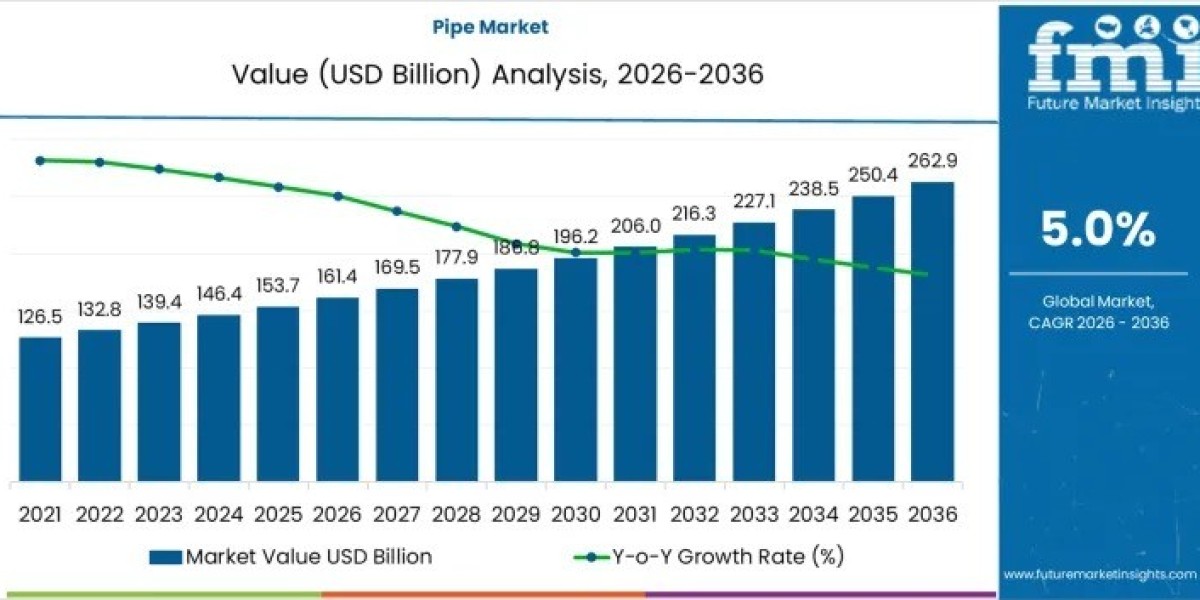

The global Pipe Market is entering a decade of structured and predictable expansion, supported by essential infrastructure development rather than short-term construction cycles. Valued at USD 161.4 billion in 2026, the market is projected to reach USD 262.9 billion by 2036, registering a CAGR of 5.0%. This growth trajectory reflects sustained capital deployment toward water distribution systems, energy transport corridors, and industrial utility networks across both mature and emerging economies.
Unlike discretionary building materials, pipes serve as long-life infrastructure assets. Demand remains anchored in replacement, rehabilitation, and regulated expansion programs, ensuring stable procurement cycles and long-term visibility for manufacturers and suppliers.
Subscribe for Year-Round Insights → Stay ahead with quarterly and annual data updates
https://www.futuremarketinsights.com/reports/sample/rep-gb-14917
Continuous data access allows stakeholders to track infrastructure budgets, material pricing trends, and regulatory developments that directly influence pipe demand across regions.
Value Creation Anchored in Replacement and Compliance
Market value formation in the pipe industry is driven by system renewal rather than greenfield construction alone. Utilities and industrial operators prioritize reliability, pressure tolerance, and compliance with evolving safety and environmental standards. Large-diameter and high-specification pipes represent a disproportionate share of market value due to higher material content, certification costs, and complex installation requirements.
Investment timing is closely aligned with public funding frameworks, long-duration energy projects, and municipal renewal mandates. This creates phased but predictable demand realization rather than volatile order cycles.
Key value drivers include:
- Aging water and wastewater infrastructure replacement
- Expansion of regulated energy transmission networks
- Industrial system upgrades requiring certified materials
- Long-term asset lifecycle optimization
Structural Constraints Shape Market Scalability
Despite consistent growth, the pipe market faces structural constraints that influence scalability across regions. Raw material exposure to steel, alloys, and polymers affects cost predictability and supplier margins. Regulatory divergence between countries increases qualification complexity and limits cross-border standardization.
Installation economics further influence adoption. Urban density, skilled labor availability, inspection regimes, and access limitations directly impact project timelines and total installed cost. Environmental compliance requirements also elevate manufacturing and coating expenditures, reinforcing the importance of operational efficiency.
Why Global Demand for Pipes Continues to Expand
Demand for pipes continues to rise as infrastructure systems require durable conduits for water, gas, and industrial fluid transport. Rapid urbanization and population growth place pressure on existing networks, accelerating investment in both expansion and rehabilitation projects. Engineers increasingly specify steel, ductile iron, and advanced polymer pipes to meet performance criteria for corrosion resistance, pressure handling, and extended service life.
Industrial facilities and process plants further reinforce demand. Piping systems are essential for managing thermal cycling, chemical exposure, and continuous operations under stringent safety protocols.
Primary demand catalysts include:
- Urban water supply and sanitation expansion
- Energy transmission and distribution projects
- Industrial process and utility piping requirements
- Lifecycle cost optimization and maintenance reduction
Metal Pipes Maintain Dominant Market Position
Metal pipes account for approximately 67.7% of global demand, representing the largest material segment. Their dominance is supported by high structural strength, pressure tolerance, and suitability for critical applications involving high temperatures and corrosive environments. Steel and alloy pipes remain indispensable in oil and gas transmission, power generation, and heavy industrial systems.
While plastic and composite pipes address corrosion resistance and weight reduction in select applications, metals continue to lead where durability, load-bearing capacity, and regulatory compliance are mandatory.
Oil and Gas Lead End-Use Industry Consumption
Oil and gas represent the largest end-use segment, accounting for nearly 38.0% of total pipe demand. Extensive upstream, midstream, and downstream operations rely on high-specification piping systems for safe and continuous fluid transport. Regulatory oversight and operational risk management reinforce sustained investment in premium pipe materials.
Beyond energy, water and wastewater utilities, construction, and chemical processing industries contribute diversified demand based on application-specific requirements.
End-use demand highlights:
- Oil and gas transmission and processing infrastructure
- Municipal water and wastewater networks
- Industrial process and utility systems
- Commercial and residential construction
Regional Growth Reflects Infrastructure Priorities
Growth patterns vary by geography, shaped by infrastructure funding cycles and industrial capacity expansion. India leads with a CAGR of 8.3%, driven by water supply, sanitation, irrigation, and gas distribution initiatives. China follows at 7.8%, supported by municipal projects, industrial parks, and pipeline replacement programs.
Canada, Italy, and the United States show moderate but stable growth, reflecting mature infrastructure bases where renewal and efficiency improvements drive demand rather than large-scale expansion.
Competitive Landscape Emphasizes Capability and Compliance
The global pipe market is defined by suppliers competing on material performance, certification, supply reliability, and technical support. Leading players such as:
- Tenaris,
- Vallourec,
- Nippon Steel
- Sumitomo Metal,
- TMK Group
benefit from strong positions in energy and infrastructure applications.
Procurement teams increasingly prioritize partners with global manufacturing footprints, adherence to international standards, and the ability to support long-duration, regulated projects.